Decentralised World

The most important commodity during the initial stages of human kind was food.
It was hard to find food to fed yourself and your family. This resulted in woman keeping the fort strong and the men hunting food with invested arrows and knifes.
Soon the humankind had to form partnerships and then communities to protect itself from other humans and animals. Then as slowly we humans evolved and gained knowledge and population , we expanded to every single corner of earth , placing our flags and building kingdoms.
Agriculture became the hottest occupation of the land and there was abundant food for most of the people. The powerful were decided by whose kingdom was the largest and had the most effective resources like water, wood , fertile soil. We need to keep in mind that humans are evolving at a rapid stage only since a couple of centuries. Agriculture and money lending had been dominating occupation since humankind.
The start of 1st Industrial Revolution initiated a shift of power from field to factory. The hottest commodity shifted from land to labour. The demand for skilled labour skyrocketed. We needed labour to run all the machines and keep churning the profitable products and make us rich and loaded.
Within a few decades of prosperity came rise of wars , over population and abundant supply of cheap labour as supply chain matured. The start of 3rd Industrial Revolution gave rise to knowledge as the hottest commodity. The USA had to forgive certain Germans for atrocious crimes against humanity just so that they could harness their potential against adversary.
With the focus on knowledge , more & more people started completing college and PHD. This gave rise to high skilled machineries, chips and computers. The era of knowledge is long gone now. Google has been the biggest reason why. We can find any kind of information with one search. It can be shops near us to deadly spiders in amazon , it can be football scores to information about a company with 500 reviews in an instant. We again have over supply of information without any kind of control. We humans mostly spend it gossiping, posting food stories or watching dumb teens do trendy dance.
The Current era is obviously the attention economy. Now we know everything is becoming digital and customers just expect smooth seamless service for absolutely free of cost. Our attention and the data these companies record is sold to advertisers for billions of $. Companies and their algorithms have been constantly trying to get us to spend as much time as possible.
If you look at all this from a wide macro angle you will notice the trend shift patterns.
More and more people shift from rural villages to cities for higher standard of living and money
Increase in power of govt by regulation every sector of economy
Centralisation of data by handful of companies
Context-
Twitter banned Trump - the leader of the free world in January 2021. Apple Google blocked Parler and AWS stopped hosting their cloud service. Whether trump and Parler deserved it is besides the point.
Apple was planning to push a CSAM program to scan our local photos without our permission for child sex offenders and has postponed(not cancelled the launch) because of the pushback from privacy community. Anti-vaccine post still dominate Facebook trend and Mark Zuckerberg does not care as long as daily active user and engagement keeps hitting record high.
When you think about it - Facebook and twitter is just a megaphone… with celebrities and politicians fighting for our attention by creating sensationalism every single hour. Google & Amazon & Facebook track your every single move and sell our data.The banks take % cut of every single transaction and cause major recessions and still get a pass from government because they are apparently too big to fail.
Solution
In the early days of the world wide web, which came into existence in 1989, you connected directly with your friends through desktop computers that talked to each other. But from the early 2000s, with the advent of Web 2.0, we began to communicate with each other and share information through centralised services provided by big companies such as Google, Facebook, Microsoft and Amazon. It is now on Facebook’s platform, in its so called “walled garden”, that you talk to your friends. Our laptops have become just screens. They cannot do anything useful without the cloud.
The DWeb (decentralised web) is about re-decentralising things – so we aren’t reliant on these intermediaries to connect us. Instead users keep control of their data and connect and interact and exchange messages directly with others in their network.
How does blockchain work ?
Imagine that a company owns a server comprised of 10,000 computers with a database holding all of its client's account information. This company has a warehouse containing all of these computers under one roof and has full control of each of these computers and all the information contained within them. Similarly, Bitcoin consists of thousands of computers, but each computer or group of computers that hold its blockchain is in a different geographic location and they are all operated by separate individuals or groups of people. These computers that makeup Bitcoin’s network are called nodes.
In this model, Bitcoin’s blockchain is used in a decentralised way. However, private, centralised blockchains, where the computers that make up its network are owned and operated by a single entity, do exist.
In a blockchain, each node has a full record of the data that has been stored on the blockchain since its inception. For Bitcoin, the data is the entire history of all Bitcoin transactions. If one node has an error in its data it can use the thousands of other nodes as a reference point to correct itself. This way, no one node within the network can alter information held within it. Because of this, the history of transactions in each block that make up Bitcoin’s blockchain is irreversible.
If one user tampers with Bitcoin’s record of transactions, all other nodes would cross-reference each other and easily pinpoint the node with the incorrect information. This system helps to establish an exact and transparent order of events. For Bitcoin, this information is a list of transactions, but it also is possible for a blockchain to hold a variety of information like legal contracts, state identifications, or a company’s product inventory.
In order to change how that system works, or the information stored within it, a majority of the decentralised network’s computing power would need to agree on said changes. This ensures that whatever changes do occur are in the best interests of the majority.
Pros of blockchain-
Completely transparent
No Security or hacking issues
No threats by Authoritarian govt
Empowering users from all over the world
No mediator taking % cut (banks govt etc)
100% working system (trust-less system as in no despotic power to any middlemen)
Permanent record
Potential Applications of blockchain
Using unique token (NFT) for buying and selling of art , movie tickets. NFT also act as a catalyst for creator economy.
Cryptocurrency provides safety and security to millions against the threat of authoritative govt or inflation
Ease in financial services and potentially saving trillions of $ given to middlemen banks
Safeguarding privacy against centralised platform
Links-
NFT- NFT Revenues
Crypto- Crypto Market August 2021 figures
Use case
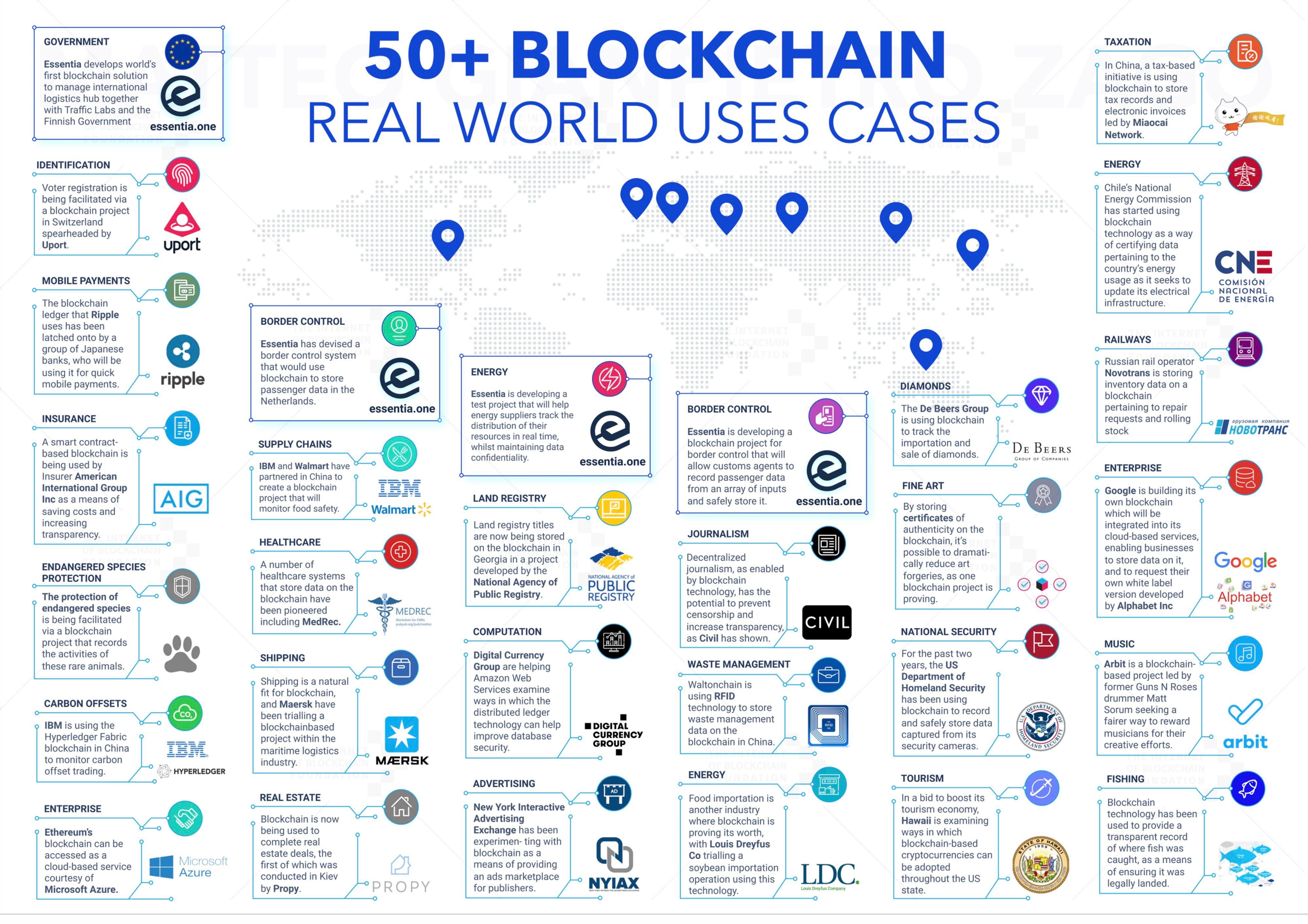
Inference -
With blockchain, we can imagine a world in which contracts are embedded in digital code and stored in transparent, shared databases, where they are protected from deletion, tampering, and revision. In this world every agreement, every process, every task, and every payment would have a digital record and signature that could be identified, validated, stored, and shared. Intermediaries like lawyers, brokers, and bankers might no longer be necessary. Individuals, organisations, machines, and algorithms would freely transact and interact with one another with little friction. This is the immense potential of blockchain.
Personal Opinion-
I truly believe that the rise of centralisation of economy and world stopped in 2008. With the rise of bitcoin-true application of blockchain technology and resentment against the elite due to fall out from the financial crisis , there is a downward path towards decentralisation. The road to peak centralisation started acceleration from 1750s and is on downward path from 2008.Yes Facebook and google are much stronger now and government is controlling even more aspects of our lives now but in the next 20 years dweb will become a perennial threat to status quo
We are in the midst of 40 years of a very rough and volatile world. Look at supply chains from all over the world and shipping rates and the graph very well might be our future. The technologies being created is at such a lightening pace that neither government regulations nor humans will be able to keep up with.
Key Points
We are moving towards decentralised network in life
The world will be -
More Risk
More Reward
More liberty
Less community
More globalised
Counter decentralisation will take place -
Rise of China and other authoritative governments.
Mainstream companies using government regulations to try to protect itself.(Exxon against climate change , Traditional financial sectors Vs Crypto firms)
Surveillance states and censorships
Rise in powerful socialist woke and far right mobs
in turn encourage decentralised web movement
Empowerment to people
Financial independence
Work from anywhere
Privacy upholding
Working in safe trust less society with no repercussions from political speech
All citizens finally become equal in the eyes of smart contract and blockchain and not cheated by elites rigging the system with help from government entities.
Note- Let me know via email if you would like real world examples of how decentralised technologies are posing threats to mainstream giants and are about to take over the world in the coming decades.